
Table of Contents
ToggleWhat is Performance Marketing ? A Complete Guide for Small Businesses
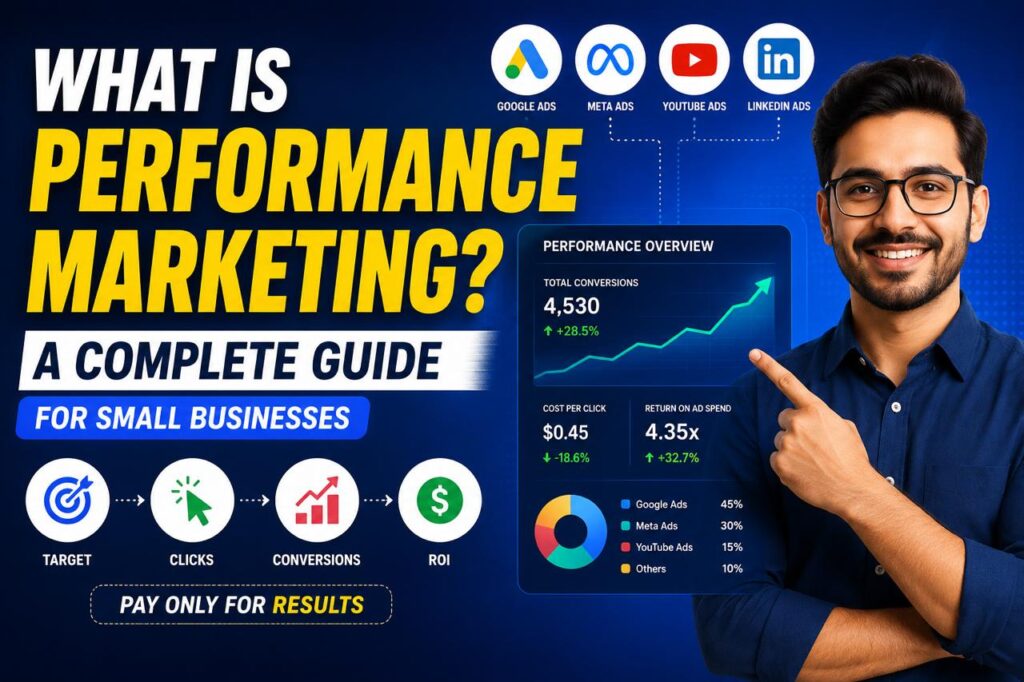
Performance marketing is a results-driven digital marketing strategy where businesses pay only when specific actions occur, such as clicks, leads, sales, app installs, or conversions. Unlike traditional advertising, performance marketing focuses heavily on measurable ROI, making it one of the most effective marketing methods for small businesses in 2026.
For small businesses with limited budgets, performance marketing offers better control over spending because every campaign can be tracked, optimized, and improved based on actual results. Platforms like Google Ads, Meta Ads, YouTube, and LinkedIn allow businesses to target highly specific audiences and monitor performance in real time.
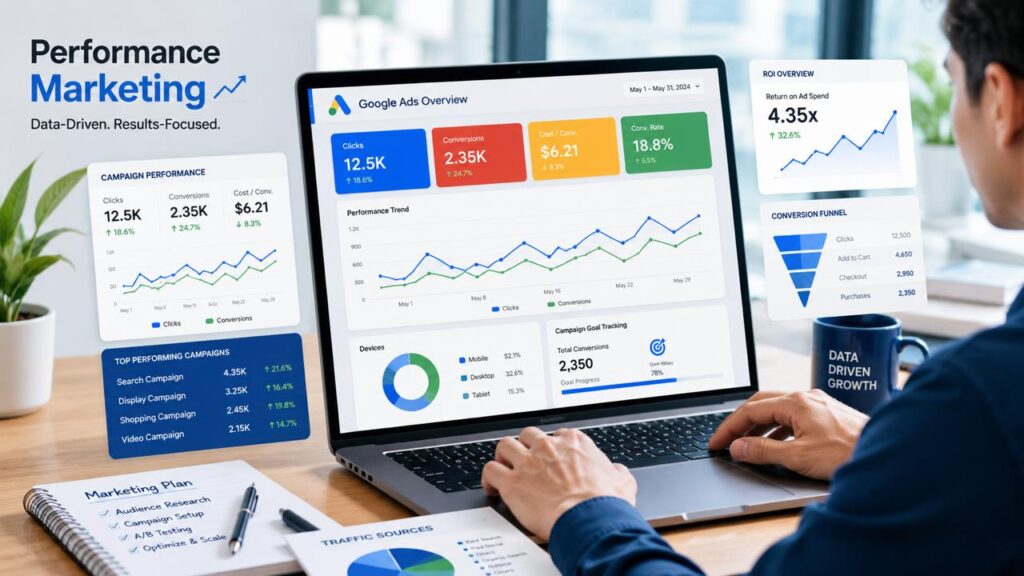
One major reason performance marketing has become so popular is transparency. Businesses can clearly track metrics such as cost per click (CPC), return on ad spend (ROAS), conversion rates, and customer acquisition cost (CAC). This helps brands understand what strategies are working and where improvements are needed.
In 2026, performance marketing is also evolving with AI-driven optimization and automation. AI tools now help businesses improve targeting, personalize ads, predict customer behaviour, and optimize campaigns automatically. Whether you run an eCommerce store, local service business, or startup, performance marketing can help generate quality leads, improve conversions, and maximize marketing ROI effectively.
Businesses looking to improve ROI-focused digital growth can also explore advanced marketing strategies at Muski Digital.
Why Performance Marketing Matters More in 2026
Digital competition has increased significantly over the last few years. Businesses are no longer competing only through pricing or products — they are competing through visibility, customer experience, and digital performance.
Customers Expect Personalized Experiences
Modern customers prefer brands that provide:
* Personalized recommendations
* Relevant advertisements
* Fast customer support
* Smooth online experiences
* Helpful content
Performance marketing helps businesses create these experiences while tracking measurable results.
Traditional Advertising Is Harder to Measure
Traditional marketing methods such as newspaper ads, billboards, and radio promotions often make ROI difficult to calculate accurately. Performance marketing solves this problem by offering detailed analytics and real-time tracking.
Businesses working with Muski Digital can build data-driven marketing campaigns focused on measurable growth and long-term customer acquisition.
How Performance Marketing Works: A Beginner-Friendly Explanation
Performance marketing works by focusing on measurable actions instead of only visibility or impressions. Businesses create digital campaigns on platforms like Google Ads or Meta Ads and pay based on user actions such as clicks, sign-ups, purchases, or inquiries.
The process usually starts with audience targeting and campaign setup. Businesses define their ideal audience using factors like demographics, interests, search behavior, location, and online activity. Ads are then shown to users most likely to engage or convert.
The online marketing process usually begins with audience research to identify target customers and understand their interests and behavior. Businesses then create marketing campaigns with engaging ads, content, and messaging designed to attract attention. Platform targeting helps brands reach the right audience through channels like Google, Instagram, Facebook, and YouTube. Conversion tracking is used to measure campaign performance, while continuous optimization helps improve ROI, customer engagement, and overall marketing results over time.
For example, if a small clothing brand runs Instagram ads for a new product launch, they only pay when users click the ad, visit the website, or complete a purchase depending on the campaign objective.
One of the biggest advantages of performance marketing is continuous optimization. Businesses can test different creatives, headlines, audiences, and landing pages to improve results over time.
Unlike traditional advertising, where performance is difficult to measure accurately, performance marketing provides real-time data. This allows businesses to scale successful campaigns and reduce spending on underperforming strategies quickly.
You can also learn more about conversion rate optimization strategies to improve campaign performance and customer acquisition.
Audience Targeting Plays a Major Role
Successful campaigns depend heavily on targeting the right audience. Businesses often segment users based on:
* Age and demographics
* Interests
* Online behaviour
* Purchase intent
* Geographic location
Better audience targeting usually improves conversion rates and reduces advertising costs.
Importance of Conversion Tracking
Performance marketing platforms allow businesses to track:
* Clicks
* Purchases
* Leads
* Website visits
* Customer actions
This data helps businesses improve campaigns continuously.
Businesses using strategies from Muski Digital can improve conversion tracking and marketing optimization more effectively.
Key Performance Marketing Strategies to Maximize ROI
To maximize ROI through performance marketing, businesses must focus on strategies that improve targeting, conversions, customer engagement, and campaign efficiency. Successful performance marketing is not only about spending money on ads, it’s about optimizing every stage of the customer journey.
One of the most effective strategies is audience segmentation. Businesses should target audiences based on demographics, interests, behaviour, and buying intent. Personalized campaigns generally perform better because users see ads that match their needs and preferences.
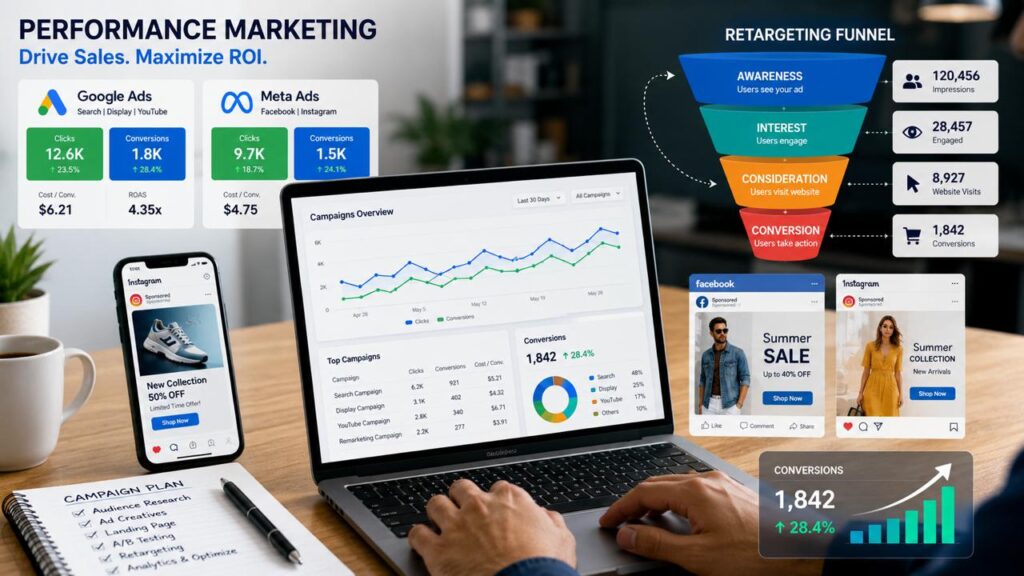
Retargeting is another highly effective strategy. Many customers visit websites without making immediate purchases. Retargeting campaigns remind these users about products or services they previously viewed, improving conversion rates significantly.
Important performance marketing strategies include retargeting ads, A/B testing, landing page optimization, audience segmentation, and video marketing. Retargeting ads help recover lost visitors by reconnecting with users who previously interacted with a website or advertisement. A/B testing improves ad performance by identifying which creatives, headlines, or calls-to-action deliver better results. Landing page optimization increases conversions through better user experience and clearer messaging, while audience segmentation improves targeting by reaching specific customer groups more effectively. Video marketing also plays a major role in increasing engagement and capturing audience attention across digital platforms.
Businesses should also focus on high-converting landing pages. A strong landing page includes clear CTAs, fast loading speed, mobile optimization, trust signals, and persuasive messaging.
Another important strategy in 2026 is AI-powered optimization. Platforms like Google and Meta now use machine learning to improve ad delivery, bidding, and audience targeting automatically.
Businesses that continuously test, analyse, and optimize campaigns usually achieve stronger ROI and more sustainable growth compared to businesses using static advertising strategies.
Importance of Retargeting Campaigns
Retargeting helps businesses reconnect with users who:
* Visited websites
* Added products to cart
* Engaged with social media
* Clicked advertisements
This strategy often improves conversion rates significantly.
Why Video Marketing Performs Better
Short-form videos and engaging visual content often generate:
* Higher engagement
* Better click-through rates
* Stronger audience retention
* Improved ad performance
At Muski Digital, businesses can explore advanced performance marketing strategies designed to improve conversions and maximize advertising ROI.
Best Platforms for Performance Marketing (Google Ads, Meta & More)
Choosing the right platform is essential for successful performance marketing because each platform serves different business goals, audiences, and campaign objectives. Small businesses should select platforms based on customer behaviour and marketing priorities.
Google Ads is one of the best platforms for high-intent marketing because users actively search for products or services. Search ads, display ads, shopping ads, and YouTube ads allow businesses to target customers across different stages of the buying journey.
Meta Ads, including Facebook and Instagram advertising, are highly effective for audience targeting, brand awareness, retargeting, and visual storytelling. These platforms work especially well for eCommerce, lifestyle brands, and local businesses.
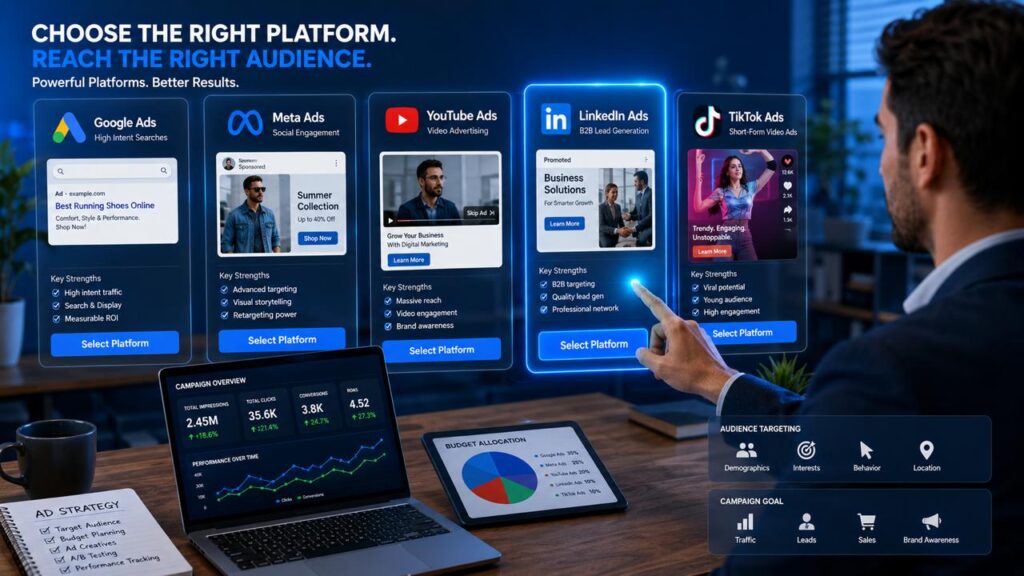
Different advertising platforms support different business goals and marketing strategies. Google Ads works best for high-intent lead generation because users actively search for products or services. Meta Ads are highly effective for social engagement, audience targeting, and retargeting campaigns across Facebook and Instagram. YouTube Ads help businesses grow through video marketing and educational content, while LinkedIn Ads are ideal for B2B marketing and professional audience targeting. TikTok Ads perform especially well for viral short-form content and younger audience engagement.
For example, a local restaurant may benefit more from Instagram ads and Google local search campaigns, while a B2B software company may perform better with LinkedIn advertising and Google Search Ads.
Businesses should also diversify platforms instead of depending on only one channel. Combining SEO, Google Ads, Meta Ads, and email marketing often creates a more stable and scalable performance marketing system.
Understanding platform strengths helps businesses allocate budgets more effectively and maximize ROI.
Google Ads for High-Intent Traffic
Google Ads are ideal for users already searching for solutions or products. These campaigns usually generate strong conversion intent.
Meta Ads for Audience Engagement
Facebook and Instagram Ads work especially well for:
* Brand awareness
* Product discovery
* Retargeting campaigns
* Visual storytelling
LinkedIn for B2B Marketing
LinkedIn Ads are valuable for:
* Professional targeting
* B2B lead generation
* Industry-specific campaigns
Businesses working with Muski Digital can build multi-platform advertising strategies optimized for long-term performance growth.
Performance Marketing vs Digital Marketing: What’s the Difference?
Performance marketing and digital marketing are closely related, but they are not exactly the same. Digital marketing is a broad category that includes all online marketing activities, while performance marketing focuses specifically on measurable results and ROI-driven campaigns.
Digital marketing includes SEO, social media marketing, email marketing, content marketing, branding, influencer marketing, and paid advertising. Some of these strategies focus on long-term awareness and relationship building rather than immediate conversions.
Performance marketing, however, focuses mainly on actions such as:
* Clicks
* Leads
* Sales
* App installs
* Form submissions
* Conversions
Digital marketing and performance marketing both help businesses grow online, but their goals and strategies are slightly different. Digital marketing follows a broader approach that includes SEO, social media, content marketing, branding, and paid advertising to build long-term visibility and customer engagement. Performance marketing, on the other hand, focuses mainly on measurable results such as leads, sales, clicks, and conversions. While digital marketing supports long-term brand growth and audience trust, performance marketing is more conversion-driven and focused on achieving faster ROI through data-based campaign optimization.
For example, SEO blog content designed to improve brand awareness falls under digital marketing, while a Google Ads campaign optimized for purchases is considered performance marketing.
Both approaches are important for business growth. Digital marketing builds trust, visibility, and audience relationships over time, while performance marketing generates measurable and scalable results faster.
Businesses that combine branding with performance-focused campaigns usually achieve stronger long-term growth and better customer retention.
Branding Still Matters
Performance marketing works best when businesses already have:
* Strong branding
* Clear messaging
* Customer trust
* Good user experience
Combining Both Strategies Creates Better Results
Businesses that combine SEO, branding, and performance campaigns often build more sustainable growth systems.
At Muski Digital, businesses can learn how branding and performance marketing work together to improve long-term business growth.
How AI is Transforming Performance Marketing in 2026
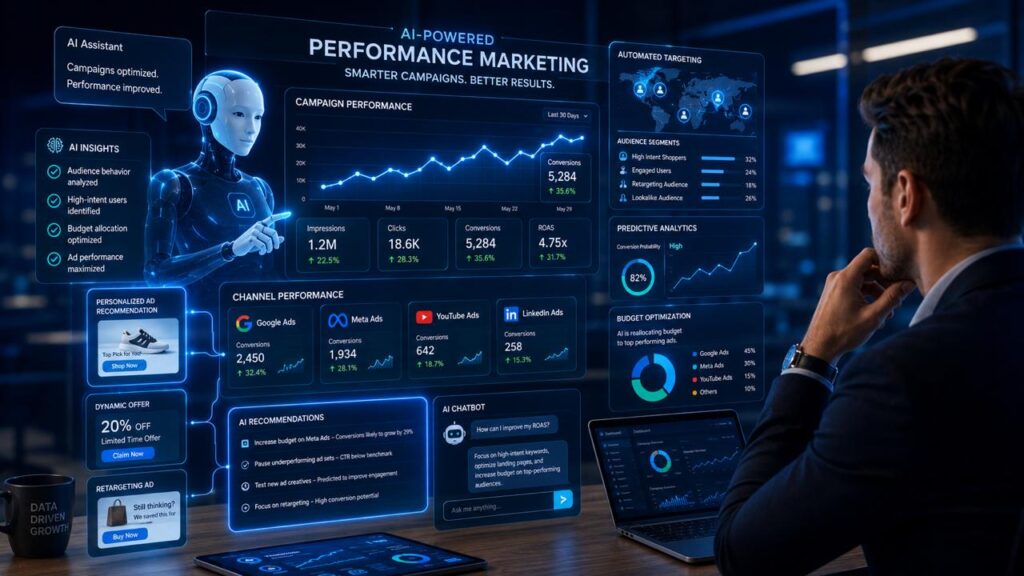
AI is transforming performance marketing by improving automation, personalization, campaign optimization, and customer targeting. In 2026, businesses increasingly rely on AI-powered tools to make marketing campaigns faster, smarter, and more efficient.
One major change is automated bidding and targeting. Platforms like Google Ads and Meta Ads now use machine learning to optimize campaigns based on user behaviour, conversion patterns, and engagement signals. This improves ad performance while reducing manual effort.
AI also helps businesses create personalized customer experiences. Modern AI tools analyse browsing behaviour, interests, and purchasing history to deliver highly relevant ads and product recommendations.
AI is playing a major role in improving performance marketing by helping businesses optimize campaigns, automate workflows, and improve targeting accuracy. Predictive analytics helps marketers identify high-intent audiences and make smarter advertising decisions based on user behaviour. AI-powered ad optimization improves conversions by automatically adjusting campaigns for better performance. Marketing automation tools also help businesses manage workflows faster, while AI content tools simplify ad copy creation and campaign messaging. In addition, chatbots provide instant customer support, improving engagement and helping businesses respond to potential customers more efficiently.
Another important trend is AI search optimization. Customers now use ChatGPT, Gemini, and AI-powered assistants to discover products and services. Businesses must optimize content for conversational search queries and AI-generated recommendations.
However, while AI improves efficiency and automation, successful performance marketing still requires human creativity, emotional storytelling, and strategic thinking. Businesses that combine AI-powered tools with strong branding and customer-focused messaging are more likely to maximize ROI and achieve sustainable growth in the evolving digital marketing landscape.
AI Improves Campaign Optimization
AI tools now help businesses:
* Predict customer intent
* Optimize bids automatically
* Improve ad delivery
* Personalize campaigns
* Generate content ideas
Conversational Search Is Growing
Businesses must now optimize content for:
* Voice search
* AI-generated recommendations
* Conversational queries
* Featured snippets
Businesses using AI-focused strategies from muskidigital.com can improve campaign performance and customer targeting more effectively.
Common Performance Marketing Mistakes Businesses Should Avoid
Many businesses waste advertising budgets because they focus only on traffic instead of conversions.
Poor Landing Page Experience
Even strong ads fail when landing pages are:
* Slow
* Confusing
* Not mobile-friendly
* Missing trust signals
Weak Audience Targeting
Targeting broad audiences often increases ad spend while reducing conversions.
Ignoring Analytics & Optimization
Businesses should continuously monitor:
* Conversion rates
* CTR
* ROAS
* Bounce rates
* Audience engagement
Performance marketing success depends heavily on continuous testing and optimization.
At Muski Digital, businesses can explore conversion-focused marketing strategies designed to improve campaign efficiency and reduce wasted advertising spend.

Conclusion
Performance marketing has become one of the most effective digital marketing strategies for small businesses looking to improve ROI, generate quality leads, and achieve scalable online growth. Unlike traditional advertising, performance marketing focuses on measurable actions such as clicks, conversions, and sales, allowing businesses to optimize campaigns based on real-time data and customer behaviour.
From Google Ads and Meta Ads to AI-driven campaign optimization and retargeting strategies, performance marketing gives businesses better control over budgets, targeting, and customer acquisition. Businesses that combine data-driven advertising with strong branding, SEO, and customer-focused experiences are more likely to achieve sustainable long-term growth.
As AI continues transforming digital marketing, businesses must also adapt to conversational search, automation tools, and personalized marketing experiences to stay competitive in 2026 and beyond.
Businesses looking to improve SEO, paid advertising, conversion optimization, and performance marketing strategies can explore growth-focused digital marketing solutions at Muski Digital.
As performance marketing continues to evolve in 2026, businesses that focus on data-driven strategies, customer behaviour analysis, and continuous campaign optimization are more likely to achieve sustainable growth and stronger ROI. Staying updated with changing advertising trends, AI-powered marketing tools, and search engine updates is equally important for long-term success. Businesses interested in learning more about performance marketing, PPC advertising, and conversion optimization can also explore valuable industry insights from Word Stream, Search Engine Land, and Google Analytics Help Center to better understand modern digital advertising and campaign performance strategies.
What is performance marketing?
Performance marketing is a digital marketing strategy where businesses pay only when specific actions occur, such as clicks, leads, sales, or conversions.
Why is performance marketing important for small businesses?
Performance marketing helps small businesses track ROI, reduce wasted advertising spend, and generate measurable results through data-driven campaigns.
Which platforms are best for performance marketing?
Google Ads, Meta Ads, YouTube Ads, LinkedIn Ads, and TikTok Ads are among the most effective platforms for performance marketing campaigns.
How does AI improve performance marketing?
AI improves audience targeting, automates bidding strategies, personalizes ads, predicts customer behaviour, and optimizes campaigns for better conversions.
What is the difference between digital marketing and performance marketing?
Digital marketing focuses on overall online visibility and branding, while performance marketing focuses specifically on measurable actions like leads, clicks, and sales.
Is performance marketing suitable for small businesses with limited budgets?
Yes, performance marketing is highly suitable for small businesses because campaigns can be optimized based on budget, audience targeting, and measurable ROI.
How can businesses improve ROI in performance marketing?
Businesses can improve ROI through audience segmentation, retargeting campaigns, landing page optimization, A/B testing, and continuous campaign analysis.